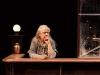
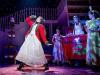
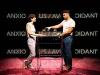
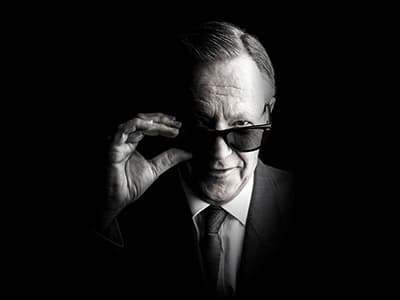
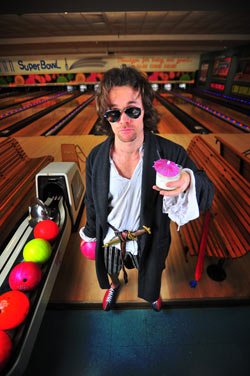
 Left - David O'Donnel. Photo - Jeremy Yao
Definitely one of my more unusual reviewing experiences, both this play and its production were unconventional to say the least, resulting in a thoroughly memorable night at the theatre.
Firstly, to the text. The Two Gentlemen of Lebowski is a “mashup” play that gained initial notoriety not as a piece of produced theatre but rather as a script circulated on the internet before later becoming an actual production with a short but highly successful off-off-Broadway run. The concept is as simple as it is audacious: what if the Coen Brothers’ cult movie The Big Lebowski had been written by William Shakespeare? Indeed, the clever title is potentially misleading, as the play borrows nothing specific from The Two Gentlemen of Verona, but rather is a scene-by-scene (indeed, virtually line-by-line) translation of the film’s plot, characters and dialogue into a faux-Shakespearian idiom.
It is an ingeniously thorough rescripting, with the film’s central character The Dude recast as “The Knave”, his companions Walter and Donny becoming Sir Walter and Sir Donald, and the text is laced with many hilarious period approximations of what would otherwise be modern anachronisms, such as cars and porno movies becoming carriages and stage shows, and Walter’s many tirades on the Vietnam War revised as the “Wars of the Orient”, etcetera. Half the fun is waiting to hear what the new “Shakespearised” versions of the film’s many memorable quotes will turn out to be, and indeed a delighted ripple of recognition passes through the audience when many other identifiable lines unexpectedly click into place in their new iambic form. Although the Shakespeare references are fleeting by comparison, many scenes paraphrase famous lines from Shakespeare’s plays in passing, audaciously appropriating them to highly amusing effect.
Of course, in this respect the play’s greatest strength is also potentially its shortcoming. It may seem churlish to say so, but one’s enjoyment of this play is almost entirely commensurate with one’s familiarity with (and love for) the original film, counterbalanced with an at least adequate exposure to Shakespeare to get the in-jokes and not be put off by the dense language. Needless to say, while a play aimed at Shakespeare-literate hardcore Big Lebowski fans may not be the most niche idea ever proposed for a play, it seems likely to curtail its appeal to the wide general public. Having seen the movie only once myself, I was still able to enjoy it a great deal, but not nearly as much as my guest, a genuine Lebowski aficionado, who in turn perhaps didn’t get quite as many of the Shakespeare puns.
That said, however, this hybridised play works oddly well (in a way that simply “Shakespearising” any other film would not automatically gel), with the Coen Brothers’ Raymond Chandleresqe slacker-movie narrative surprisingly comparable to the often convoluted plots of Shakespeare’s comedies. In both cases it is the memorable characters and pithy dialogue that carry the show, not the intricacies of the story itself, and indeed there is something surprisingly… Shakespearian about the foolish, lazy Dude, the blithely inattentive Donny, and especially the somewhat Falstaffian Walter, each a unique creation with manifold flaws and yet an inexplicably endearing believability, despite their exaggerated personalities.
This production is similarly something of an oddity, being, to the best of my understanding, a kind of one-night-only trial run for a potentially quite abridged manifestation in the “World’s Funniest Island” comedy festival later in the year, spearheaded by NIDA Directing alumnus Dave Harmon. Having secured the rights from Universal Pictures and produced on an apparently shoestring budget, Harmon’s show is by his own description something rather akin to the production style of the Sydney University Dramatic Society (his prior theatrical alma mater), with scant rehearsal and resources, but this seems quite fitting for a show of this nature. Indeed, it was perhaps fate that what was originally designed as an outdoor performance in Sydney Uni’s magnificent main quad was subject to an eleventh hour change of venue due to rain, resulting in the show being staged in the Cellar Theatre, SUDS’ long-term makeshift performance space. While the grand plan of the gothic surrounds would doubtless have worked well, there was something appropriate about this venue for such an inherently undergraduate text, and all the verve, cleverness and cheeky humour that it implies.
That the resulting show was merely a little rough around the edges is testament to Harmon’s direction and evident enthusiasm for the material, having had to drastically re-block the entire show for a radically different venue on the very day of the performance, and no less impressive was the energetic cast’s ability to follow through. Indeed, the cast was tremendously lively, and what some may have lacked in polish was more than made up for in zeal and mirth.
David O'Donnel, Jon Williams and David Bloustien were each a hoot in the key roles of The Knave, Sir Walter and Sir Donald respectively, while Liam Bradbery and Carlo Ritchie also made uproarious turns as Brandt and Sir Geoffrey of Lebowski. The show was perhaps in danger of being stolen, however, by the devastatingly hilarious appearances of Steen Raskopoulos as The Jesus, the deviant bowler memorably played by John Tuturro in the original film, given an audacious musical spotlight in this stage version. With some surprisingly impressive costumes reportedly loaned from the Society of Creative Anachronisms, each character very much looked the part as a delirious mélange of Elizabethan armour and finery spliced with early ‘90s Grunge. The inclusion of live music was the icing on this theatrical cake.
An oddball production of an altogether bizarre play, this was a unique night of theatre that was as effective as it was improbable. With a receptive audience in high spirits, it was an experience to be fondly remembered.
Verge Festival
Two Gentlemen of Lebowski
Directed by Dave Harmon
Venue: Quadrangle, University of Sydney
Date/Time: 6pm, Thursday 9 September, 2010
Tickets: $10 Access, $15 General Admission
Tickets available from the Access Desk and on the door
Visit: www.vergefestival.com